What Does Open-Source AI Actually Open?

Quick answer: “Open-source AI” should describe the freedoms and materials needed to use, study, modify, and share an AI system—not merely the ability to download model weights. Check the weights, inference and training code, information about the training data, and the license for each component. “Open weights” is a useful, narrower description when the full conditions are not met.
Open is a set of inspectable rights and resources, not a vibe.
Key facts
- The Open Source Initiative released the Open Source AI Definition 1.0 as a definition anchor.
- Downloadable parameters can be open weights without making the whole AI system open source.
- Licenses determine what you may use, modify, and redistribute; access alone is not permission.
- Data information matters even when distributing the original training dataset is not required.
- Open does not automatically mean free of cost, private, safe, reproducible, or small enough to run locally.
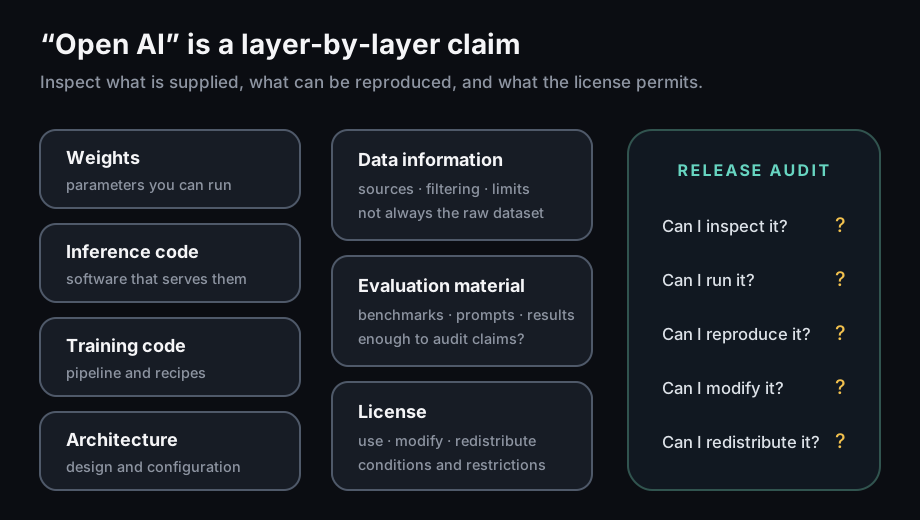
The layers to inspect
| Layer | Question to ask | Why it matters |
|---|---|---|
| Model parameters | Can I obtain and modify the weights? | Determines whether inference and adaptation can happen outside one provider |
| Inference code | Can I run the model with inspectable software? | Affects portability, debugging, and deployment |
| Training code | Are the methods and code needed to understand or modify training available? | Affects meaningful study and modification |
| Data information | Is sufficient information provided about data provenance, selection, processing, and characteristics? | Helps people understand and reproduce the system |
| License | Do the terms permit use, study, modification, and sharing? | Converts technical access into legal rights |
| Documentation | Are architecture, limitations, intended use, and evaluation details explained? | Makes practical assessment possible |
The exact artifact set depends on the system, but the audit must go beyond a repository badge.
Open source vs open weights
Open weights generally means the trained parameters are available under stated terms. That can enable local inference, fine-tuning, quantization, research, and deployment without sending each request to the original provider.
It may still omit training code, detailed data information, or broad rights to modify and redistribute. Restrictions on fields of use, user counts, commercial activity, or derived models can also matter. Under the OSI's Open Source AI Definition 1.0, weights alone are not enough.
That does not make open-weight releases worthless. It makes precise labeling important.
Two hypothetical model releases
Assume a team needs an internal summarization model.
Release Cedar provides downloadable weights, inference code, training and data-processing code, documented data information, and licenses that permit use, study, modification, and sharing.
Release Harbor provides downloadable weights and a model card, but prohibits several use categories, withholds training code, and gives little information about data preparation.
Both may run on the team's hardware. Both may be useful. Only the first has a strong case across the full open-source AI stack. Calling both “open” hides the difference the team must manage.
What openness does—and does not—tell you
Openness can improve portability, inspection, experimentation, customization, and exit options. It may let a team keep inference on infrastructure it controls.
It does not prove:
- that the model's training data was lawful or bias-free;
- that the code has no vulnerabilities;
- that local deployment is configured privately;
- that the model will fit available memory or meet latency targets;
- that operating it costs less than a managed service;
- that results are reproducible from the released materials;
- that every downstream use is permitted.
Evaluate those claims independently.
A practical release checklist
For any candidate, record the exact version and date, then inspect:
- the named license for every important component;
- rights and restrictions for use, modification, and redistribution;
- weight format and access conditions;
- inference and training code availability;
- data provenance and processing information;
- model card, limitations, evaluations, and intended uses;
- required hardware and supported runtimes;
- dependencies that still call an external service.
If a material answer is missing, write “not established” instead of assuming it is open.
Where Agenaxy fits
Agenaxy treats models as replaceable labor inside a user-owned Space. A workflow can select a local model, another compatible runtime, or an approved cloud model without making the provider the owner of the workspace. That model freedom is broader than license classification: it is the ability to preserve files, rules, evidence, sessions, and artifacts while changing the model.
Next, compare open-source and closed-source AI on one workload, or separate inference location from product architecture in local AI vs cloud agents.
Test a model-flexible workflow
Describe a bounded task in which model portability matters through an Agenaxy beta request. Do not submit confidential documents, customer records, credentials, or production data.
FAQ
Does open-source AI require releasing the entire training dataset?
The OSI definition focuses on access to the preferred form for making modifications, including sufficiently detailed data information. The original dataset may involve rights or privacy constraints; inspect the definition and the release materials for the specific case.
Is an open-weight model always free for commercial use?
No. Read the current license. Download access does not establish commercial rights or the absence of restrictions.
Is open-source AI automatically local?
No. Open components may be deployed locally, remotely, or through a hosted service. “Open” describes freedoms; “local” describes where parts of the system run or store data.
Sources and Fact-Checking Notes
- Open Source AI Definition 1.0 defines the freedoms and system materials OSI considers necessary for open-source AI.
- OSI — Open Weights explains why weight availability alone is a narrower category.
- OSAID FAQ answers common questions about data, code, and system components.
- Hugging Face model cards documents a common mechanism for publishing model information; a model card does not replace the license.