What Is an AI Agent? How Is It Different From AI?

Quick answer: AI is the broad field of building systems that perform tasks associated with intelligence. An AI agent is a particular kind of system: it receives a goal, decides what to do next, uses permitted tools, observes the result, and continues until it finishes, asks for help, or reaches a stopping condition.
A model can write an answer. An agent surrounds a model with the state and capabilities needed to pursue work.
AI, models, and agents are different layers
| Term | What it describes | Example |
|---|---|---|
| Artificial intelligence | The broad field and capability category | Language, vision, prediction, planning |
| AI model | A trained component that maps inputs to outputs | A language model producing text or tool requests |
| AI application | Software built around one or more models | A chat app, transcription tool, or document search UI |
| AI agent | A system that selects and executes steps toward a goal | An agent reading files, updating a report, and checking its work |
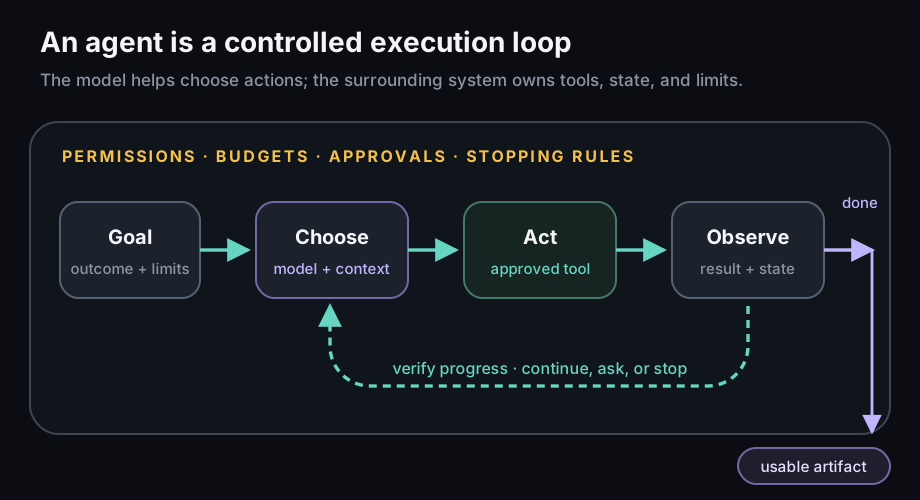
Calling a language model does not automatically create an agent. The system becomes agentic when the model's output can influence the next action in a controlled loop.
The parts of an AI agent
Most useful agents need seven things:
- A goal: the outcome and constraints supplied by the user.
- A model: the reasoning or generation engine.
- Context: relevant messages, files, rules, memory, and tool results.
- Tools: typed ways to read, search, calculate, write, or call other systems.
- A loop: choose an action, execute it, observe the result, and decide what follows.
- Controls: permissions, approvals, budgets, sandboxes, and stopping rules.
- A result: a response, changed file, report, table, or another usable artifact.
The model is important, but it is not the whole product. Two agents using the same model can behave very differently because their tools, context, permissions, and verification rules differ.
An illustrative example
Suppose you ask, “Prepare this month's expense report from these receipts.” This is a hypothetical workflow, not a report from a real Agenaxy customer or benchmark.
A model can explain how to make the report or draft a table from text pasted into a prompt. An agent can:
- inspect the receipt files it is allowed to read;
- extract merchant, date, tax, currency, and amount;
- flag duplicates or unreadable fields;
- calculate totals with a deterministic tool;
- write a spreadsheet and source-linked exception list;
- ask you to clarify an ambiguous receipt;
- verify that the output totals reconcile to the inputs.
The valuable difference is not that the prose sounds smarter. The system moved through the work and returned something you can inspect and continue using.
An agent is not unlimited autonomy
Agency describes an execution pattern, not a blank check. A reliable agent should know which actions are automatic, which require approval, which are blocked, and what evidence must be preserved.
For example, reading a copied receipt inside a task workspace may be low risk. Sending the spreadsheet by email creates an external side effect and should require a different permission. Approval and technical isolation are also different: a user can authorize a command, but a sandbox still limits what the process can reach.
When should you use an AI agent?
An agent is a good fit when the task:
- needs several steps whose next action depends on intermediate results;
- combines unstructured material with tools or deterministic computation;
- produces files or artifacts, not merely advice;
- benefits from retries, verification, and visible exceptions;
- remains bounded enough to define permissions and a stopping condition.
Use a normal model call, search, script, or workflow instead when the task is one-shot, fully deterministic, cheap to express as rules, or too consequential to delegate without a mature control system.
Where Agenaxy fits
Agenaxy is a local-first AI agent workbench. A Space holds the files, rules, memory, model preferences, permissions, sessions, execution evidence, and artifacts for a body of work. The agent can use a selected local or cloud model, but the model remains replaceable labor rather than the owner of the workspace.
The workbench makes the rest of the agent system visible: what context entered the run, which tools acted, what needed approval, what changed, and which artifact was delivered. For sensitive projects, Vault is Agenaxy's public name for Local Privacy Mode: it permits local models and local tools only, hard-denies network access (including remote models, remote MCP servers, network Skills, and outbound commands), and fails closed if that boundary cannot be enforced. Standard mode can use either local or selected cloud models.
Next, compare an agent with a chatbot, copilot, and assistant or see what makes the whole workbench local-first.
Test one bounded agent workflow
Bring one file-heavy, multi-step workflow to an Agenaxy beta request, such as turning a copied set of receipts into a reviewable expense report. Describe the workflow shape only: do not submit confidential documents, customer records, credentials, or production data through the request form.
FAQ
Is ChatGPT an AI agent?
A chat product can include agentic capabilities, but a conversational model response by itself is not an agent run. Look for a goal-directed loop, tools, observations, state, and controls rather than relying on the brand label.
Do AI agents need multiple models?
No. One agent can use one model. Models may be switched or routed for quality, cost, privacy, or capability, but multiple models are not part of the definition.
Sources and Fact-Checking Notes
- Anthropic — Building effective agents distinguishes predefined workflows from systems where models direct their own process and tool use.
- Agenaxy claims are checked against its Space, agent execution, tool, permission, Trace, and Artifact canon.