AI Agent Workbench vs Workflow Automation Platform: Which Should Own the Task?
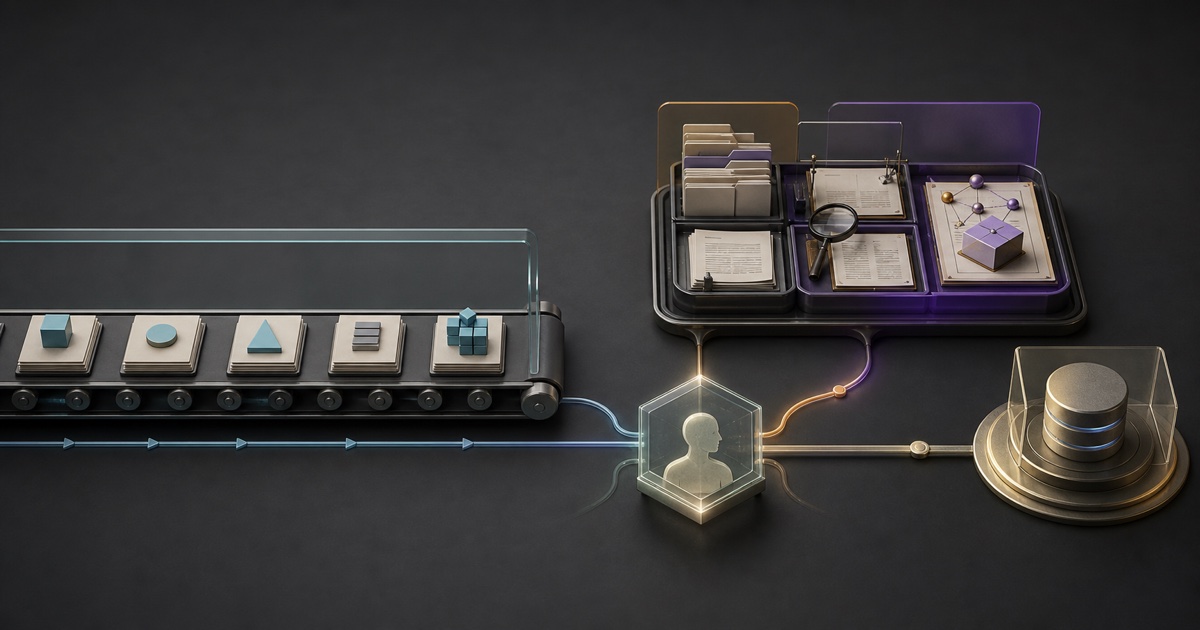
Quick answer: Use a workflow automation platform when a known trigger should run a predictable sequence of integrations and rules. Use an AI agent workbench when a person gives a goal, the work depends on files and intermediate evidence, and the useful result is a reviewable artifact plus an execution trace. Combine them when fixed steps and judgment-heavy exceptions can meet at explicit handoff and approval boundaries.
“Agent workbench” is an operational category in this article, not a settled industry standard.
Key facts
- Deterministic workflow automation is usually better for repeated, stable system-to-system steps.
- Agent workbenches are useful for context-rich tasks whose next step depends on intermediate evidence.
- An agent can be one node inside an automation; an automation can be one tool called by an agent.
- Human approval should sit before consequential writes, not after a vague success message.
- Neither category automatically guarantees reliability, privacy, security, or auditability.
Workbench vs workflow automation
| Dimension | AI agent workbench | Workflow automation platform |
|---|---|---|
| Primary input | Human goal, files, context, constraints | Trigger, event, schedule, or form |
| Control flow | Model-guided within tools, policy, and stopping rules | Predefined nodes, branches, rules, and retries |
| Best work | Research, analysis, drafting, exception handling, artifact creation | Repeated integrations, routing, synchronization, notifications |
| State | Project workspace, sessions, evidence, intermediate and final artifacts | Run state, node outputs, credentials, integration records |
| Human role | Directs, clarifies, reviews, and continues work | Designs the flow and handles exceptions or approvals |
| Variability | Expected and bounded through controls | Minimized through explicit paths |
| Evaluation | Outcome quality, evidence, decisions, tool use, artifact | Trigger correctness, node behavior, data mapping, delivery |
| Common failure | Unsupported reasoning or unverified completion | Broken integration, bad mapping, retry duplication, path drift |
Modern products increasingly blend both columns. Evaluate the behavior that owns your task.
Illustrative example: weekly financial close
This is a synthetic workflow, not financial advice, a customer result, or a benchmark.
Every Friday, the organization must prepare a close pack:
- pull ledger and payment records from fixed systems;
- collect spreadsheets and commentary from several folders;
- reconcile totals and explain unusual variances;
- produce a reviewable report;
- obtain approval;
- post an approved status and archive the pack.
The automation platform should own the schedule, stable API pulls, schema checks, file routing, notifications, and final approved system write.
The agent workbench should own reading the collected files, relating unstructured commentary to variance records, drafting explanations, building the report artifact, and presenting unresolved exceptions with evidence.
The handoff into the workbench should contain immutable source references, period, schema, and success checks. The handoff back should contain the artifact, reconciled totals, exception list, evidence links, and approval state. The automation must not interpret “report prepared” as authorization to post.
When workflow automation should own the task
Choose deterministic automation when:
- the trigger and destination are known;
- each step can be expressed as a stable integration or rule;
- failures should follow predefined retry and escalation paths;
- structured data mappings dominate;
- volume and repeatability matter more than open-ended judgment.
Adding a language model to one node does not require turning the full workflow into an agent.
When an agent workbench should own the task
Choose a workbench when:
- a human begins with a goal rather than a fixed event;
- evidence lives in documents, tables, images, or mixed files;
- the plan must adapt after intermediate observations;
- clarification and judgment are expected;
- the result is an artifact that a person will inspect and continue using;
- the complete context and execution path should remain attached to a project.
Bound the work with tool permissions, budgets, checkpoints, and acceptance tests.
When a hybrid is better
Use automation as the reliable transport and trigger layer. Use the agent for the smallest judgment-heavy segment. Pass typed inputs and outputs rather than an unstructured “do the thing” message.
Before any external write, show the exact target, payload, evidence, and consequence. Use stable idempotency keys and verify ambiguous outcomes before retrying. Preserve a shared correlation ID so both systems' traces can be reconciled.
Limits and category drift
Workflow platforms increasingly add agents, chat surfaces, and human steps. Workbenches can schedule tasks and call APIs. Product marketing therefore cannot decide architecture.
Ask who owns the primary context, who decides the next step, where durable artifacts live, how permissions are enforced, and how completion is verified.
Where Agenaxy fits
Agenaxy is a local-first AI agent workbench, not a visual workflow builder. A Space holds files, rules, memory, model preferences, permissions, sessions, execution evidence, and artifacts. It is designed for goal-directed work that produces user-owned outputs.
It can participate in a wider process through explicit tools and artifacts without pretending every deterministic integration belongs inside the agent. For the adjacent distinction, compare AI agents with workflow automation or inspect an agentic workspace.
Key takeaways
- Stable triggers and known steps favor workflow automation.
- Context-rich judgment and artifact creation favor an agent workbench.
- A hybrid should have typed handoffs, correlation IDs, and one owner per side effect.
- Approval and external-state verification belong at consequential boundaries.
- Choose based on task control and durable evidence, not product labels.
Decompose one hybrid workflow
Describe one stable segment, one judgment-heavy segment, one artifact, and one consequential boundary in an Agenaxy beta request. Do not submit financial records, confidential documents, customer data, credentials, or production data.
FAQ
Is an AI agent just a workflow with a model node?
Not necessarily. An agent lets model-guided decisions influence the next action within controls. A fixed workflow can call a model without delegating control flow.
Can an agent replace an automation platform?
It can perform some overlapping work, but stable integrations, event handling, and deterministic routing often remain better expressed as automation.
Which system should send the final update?
Assign one owner. The workbench can produce an approved payload; the automation can perform the external write and verify it. Avoid letting both sides retry the same action.
Sources and Fact-Checking Notes
- OpenAI, A Practical Guide to Building Agents supports the agent definition, tool use, guardrails, and guidance to prefer deterministic solutions when sufficient.
- n8n, AI agentic workflows and Gumloop Agents are dated vendor examples of category convergence, not neutral standards.
- “AI agent workbench” is explicitly an operational category for this article.
- Agenaxy statements are checked against its Space, agent loop, permission, Trace, Artifact, and “not a visual workflow builder” canon.