AI Agents vs Workflow Automation: Which Should You Use?
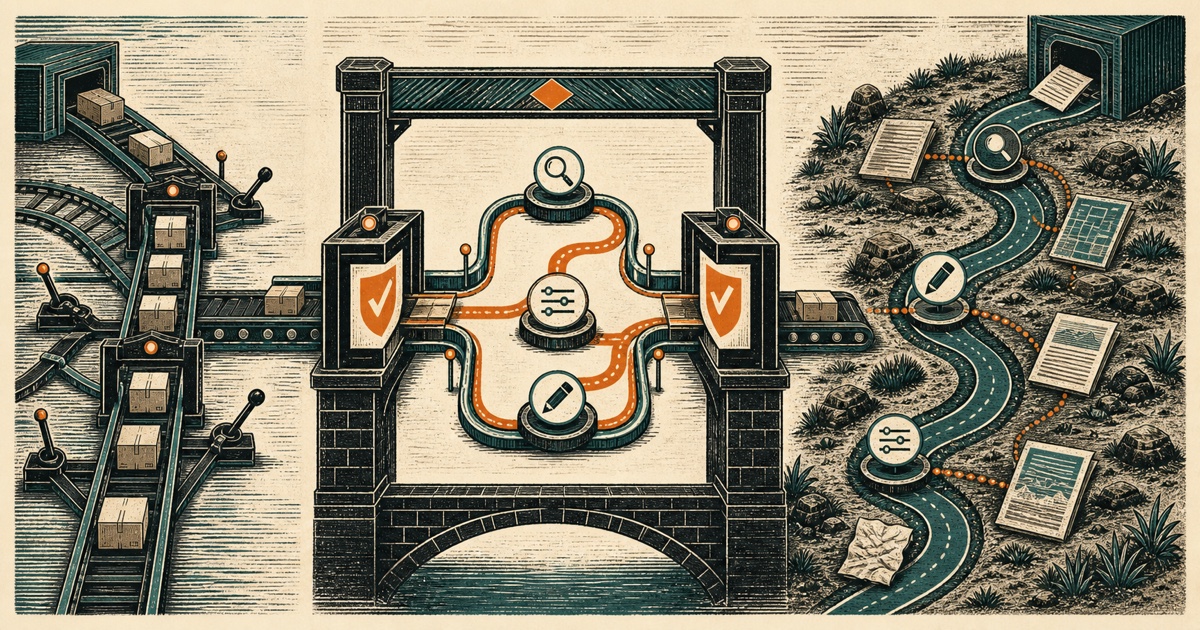
Quick verdict: Use workflow automation when the steps and conditions are known in advance. Use an AI agent when the task contains bounded ambiguity and the next step depends on what the system discovers. Use both when a deterministic workflow can contain, validate, and route an agentic step.
What workflow automation does
Workflow automation connects predefined triggers, rules, actions, and branches. A new form submission may create a record, check fields, route it by region, notify an owner, and update status. The designer decides the paths before the workflow runs.
That predictability is a strength. Stable workflows are easier to test, monitor, explain, and replay.
What an AI agent does
An agent receives a goal and can decide which allowed action to take next. It may inspect a document, search for evidence, call a calculation tool, notice an exception, and revise its plan. The path emerges during the run, within a policy and stopping boundary.
| Decision factor | Workflow automation | AI agent |
|---|---|---|
| Process path | Predefined | Chosen during execution |
| Best input | Structured and stable | Unstructured or variable |
| Testing | Enumerate paths and rules | Evaluate behaviors and outcomes |
| Exceptions | Must be modeled | Can interpret bounded novelty |
| Reproducibility | Usually high | Lower; model and context matter |
| Oversight | Monitor failed steps | Also inspect reasoning inputs, tools, and artifacts |
One invoice-intake process
Consider this illustrative invoice-intake process: invoices arrive by email, but no real customer workflow or benchmark is being represented.
A workflow should handle:
- accepting supported file types;
- calculating hashes and detecting exact duplicates;
- validating required fields;
- applying tax or routing rules;
- updating a system of record;
- notifying the assigned owner.
An agent may help when:
- supplier layouts vary;
- a field is ambiguous;
- the invoice references an unusual contract clause;
- the exception needs a source-backed explanation;
- a human-readable reconciliation memo is required.
The strongest design is often hybrid. Deterministic steps receive and validate the invoice. A bounded agent examines only exceptions. Deterministic checks then verify totals and route any consequential decision to a person.
Choose workflow automation when
- rules cover nearly all cases;
- exact repetition is valuable;
- inputs are structured;
- the process causes external side effects;
- audit requires a known path;
- a conventional integration can solve the job.
Choose an AI agent when
- documents, language, or evidence determine the next step;
- the task needs search, comparison, or iterative repair;
- the output is a draft or artifact a person can inspect;
- exceptions are common but remain bounded;
- you can define tools, permissions, and failure behavior.
Choose neither when
Do not add an agent or workflow platform just to avoid a small formula, query, or script. Complexity has an operating cost: credentials, monitoring, failure recovery, version changes, and unclear ownership.
Where Agenaxy fits
Agenaxy is an agent workbench, not a visual workflow builder. It is designed for work where the agent needs a Space with project files, rules, memory, tool permissions, execution evidence, and artifacts. Deterministic tools and checks can operate inside a run, but the product is not meant to replace high-volume event routing or drag-and-drop business process automation.
Continue with what an AI agent is and review the local-first workbench category.
Test a hybrid workflow boundary
If one document process combines stable routing with messy exceptions, describe that boundary in an Agenaxy beta request. Include the desired artifact, deterministic checks, and human checkpoints, but do not submit invoices, customer records, credentials, or production data through the request form.
FAQ
Is an LLM step inside a workflow an AI agent?
Not by itself. If the workflow chooses every step and the model only transforms one input, it remains a workflow with an AI component.
Can agents trigger traditional workflows?
Yes, if the tool and permission boundary permits it. External side effects should receive stronger controls than internal drafting or analysis.
Are AI agents replacing automation platforms?
They overlap but solve different problems. Automation platforms excel at predefined integration paths; agents help with bounded interpretation and adaptive execution.
Sources and Fact-Checking Notes
- Anthropic — Building effective agents supports the distinction between predefined workflows and model-directed processes.
- This comparison describes architectures, not a guarantee about any vendor's implementation.