How Do AI Agents Stay Reliable? A Practical Control Stack

Quick answer: AI agents stay reliable when the whole system is engineered around a bounded task and an observable definition of success. That requires relevant context, typed tools, least privilege, budgets, human checkpoints, environment-based verification, traces, evaluations, and recovery. A confident “done” message from the agent is not evidence that the work succeeded.
Reliability is not determinism. It is the measured ability to achieve an intended outcome within stated limits.
Key facts for AI agents
- Evaluate the delivered outcome and environment state, not only the final text response.
- Narrow task boundaries usually improve reliability more than a vague request for better reasoning.
- Guardrails are layered; no prompt, model, approval step, or sandbox covers every failure mode.
- Tool schemas, permissions, budgets, and stopping rules constrain execution before errors spread.
- Logs and traces explain a run; repeatable evals determine whether the system is improving.
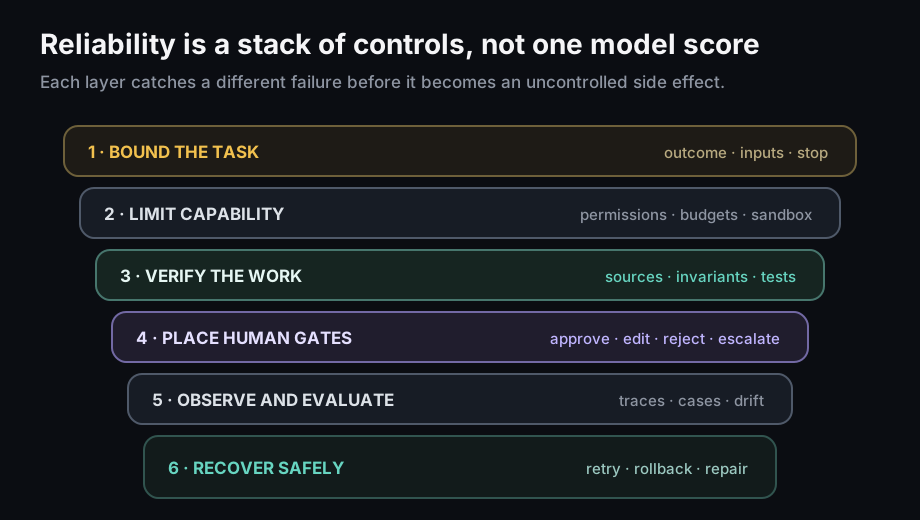
The reliability control stack
| Layer | Core question | Example control |
|---|---|---|
| Task contract | What counts as success, failure, or escalation? | Acceptance checks and exception rules |
| Context | Does the agent have the right evidence and instructions? | Source scope, dates, precedence, provenance |
| Tools | Can actions be expressed and validated precisely? | Typed inputs, deterministic calculations, idempotency |
| Permissions | What is the maximum reachable impact? | Least privilege, sandboxing, network boundaries |
| Runtime | Can the loop run away or repeat side effects? | Time, token, retry, and action budgets |
| Human control | Which decisions need judgment or authorization? | Reviewable checkpoints |
| Verification | Did the external state actually match the goal? | Re-read files, query records, reconcile totals |
| Evidence and recovery | Can someone inspect, resume, or address the work? | Traces, checkpoints, artifacts, recovery and reconciliation plans |
| Evaluation | Does the system work across representative cases? | Task suites, failure taxonomies, regression thresholds |
The stack is intentionally redundant. A malformed invoice should be caught by input validation; if it is not, reconciliation should expose the mismatch; if posting is still proposed, approval should show it; if a partial write occurs, recovery should contain the damage.
Illustrative example: invoice processing
This is a synthetic workflow, not a customer result or performance benchmark. Consider an agent processing a batch of supplier invoices. A weak design asks the agent to “handle these invoices” and trusts its summary. A reliable design separates stages:
- extract vendor, invoice number, dates, currency, tax, and line totals;
- validate required fields and detect duplicates;
- reconcile arithmetic with deterministic code;
- match the invoice to an approved purchase order;
- produce an exception queue for ambiguous cases;
- require approval before posting;
- query the accounting system to verify the exact record created;
- return a source-linked artifact and execution receipt.
If the agent says an invoice was posted but the accounting record is absent, the task is not complete. Environment verification outranks self-report.
Define reliability before choosing a model
Write the task contract in observable terms. For invoice processing, that may include field accuracy, duplicate-detection recall, arithmetic equality, the percentage of cases correctly escalated, zero unapproved postings, and exact agreement between proposed and created records.
Then assemble an evaluation set that includes common cases, edge cases, malformed inputs, conflicting records, tool failures, and attempted instruction injection. A single polished demo does not estimate behavior across the distribution that matters.
Model quality matters, but the best model cannot compensate for an undefined goal, excessive permissions, or missing verification.
Bound the agent loop
Useful agents adapt after observations, but adaptation needs limits. Specify maximum steps, retries, elapsed time, token or cost budgets, allowed tools, and conditions for stopping or escalating.
Where the target supports it, use a stable idempotency key and durable side-effect status across retries. After a timeout or ambiguous result, query the target system before retrying; if the outcome cannot be established, stop and escalate. Separate read, propose, approve, execute, and verify operations so a failure has a clear recovery point. Irreversible actions such as sending, paying, or publishing may require compensation, reconciliation, or human handling rather than rollback.
Use human review where judgment matters
People should review high-impact or ambiguous proposals, not every routine read. Show the exact target, payload, evidence, and consequences. Approval remains distinct from technical isolation: a reviewer can authorize an action while a sandbox still prevents unrelated access.
See human-in-the-loop AI agents for checkpoint design.
Trace, evaluate, and repair failures
A trace should connect instructions, context, tool requests, results, decisions, approvals, and artifacts. It helps explain what happened. An evaluation asks whether that behavior met the task contract across cases.
Classify failures by layer: wrong source, bad extraction, invalid tool call, permission breach attempt, repeated side effect, missed escalation, unverifiable completion, or recovery failure. Repair the responsible layer instead of adding an increasingly long prompt to every problem.
Limitations
No control stack proves an agent is correct in every environment. Models, tools, source data, and external systems change. Rare interactions emerge after deployment. Tight controls may also reduce capability or speed.
Reliability is therefore a maintained case: current eval evidence, bounded permissions, operational monitoring, and a path to stop, inspect, and recover.
Where Agenaxy fits
Agenaxy organizes agent work inside a Space with explicit context, model choice, tool policy, approvals, execution evidence, and artifacts. Capability boundaries and sandboxing limit reach. Durable checkpoints and pending-operation state support recovery and continuation, while PendingRequest exposes the decision the user must make. Trace and Audit views make the path inspectable; artifacts remain owned by the user rather than trapped in a transient response.
For a simpler choice between flexible execution and fixed processes, see AI agents vs workflow automation.
Key takeaways
- Reliability is an end-to-end, outcome-measured system property.
- Bound tasks, tools, permissions, retries, time, and side effects.
- Verify the environment rather than trusting “done.”
- Use approvals for judgment and authorization, not as a substitute for isolation.
- Turn failure traces into representative regression tests.
Test one repeatable workflow
Describe a workflow with explicit success checks, exception paths, and one bounded side effect in an Agenaxy beta request. Do not submit confidential documents, customer records, credentials, or production data.
FAQ
Can AI agents be 100% reliable?
No general-purpose system can promise perfect behavior across changing inputs and environments. Reliability should be measured for a bounded task with stated thresholds and residual risks.
Are guardrails just prompts?
No. Prompts are one layer. Tool validation, least privilege, sandboxing, budgets, approvals, verification, monitoring, and recovery provide controls that instructions alone cannot.
What is the most important agent reliability test?
Check the actual outcome. Re-read the changed file, query the external record, reconcile the totals, or inspect the delivered artifact against acceptance criteria.
Sources and Fact-Checking Notes
- NIST AI Risk Management Framework provides a voluntary framework for managing AI risk.
- OpenAI, A Practical Guide to Building Agents discusses tools, instructions, guardrails, and human intervention in agent systems.
- Anthropic, Demystifying evals for AI agents covers task-based evaluation design and agent-specific complexity.
- Agenaxy claims are checked against its capability policy, sandbox, approval, checkpoint, Trace, Audit, and Artifact canon.