MCP vs API vs Plugin vs Skill: Which Integration Layer Does What?

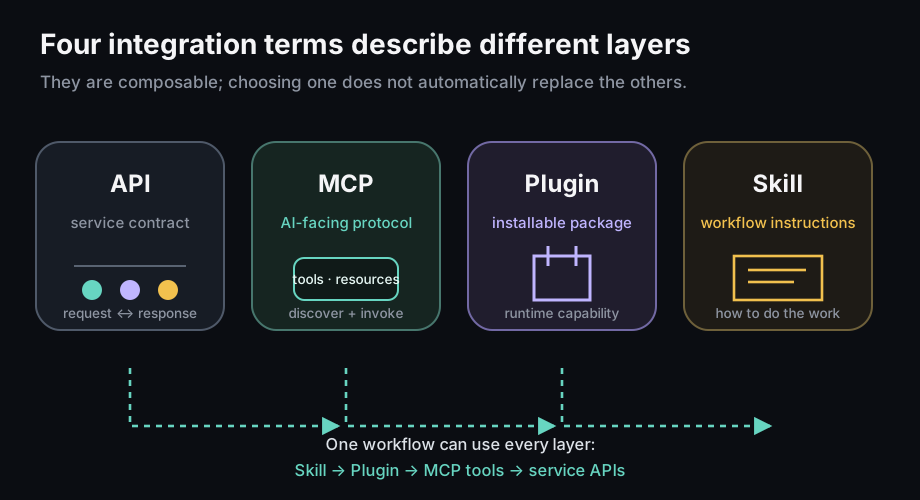
Quick answer: An API exposes operations or data from a service. MCP, the Model Context Protocol, standardizes how an AI host connects to servers that expose tools, resources, and prompts. A plugin is an installable extension package for a particular product runtime. A skill is a reusable set of instructions, knowledge, or procedure that guides an agent. They are layers that often compose, not four competing choices.
MCP complements APIs. It does not replace them.
Key facts
- An MCP server may call an ordinary REST or database API behind the scenes.
- MCP discovery tells a host what a server offers; it does not automatically authorize every action.
- Plugins are product-specific packages and may include code, configuration, MCP servers, or skills.
- Skills primarily shape behavior, but host-specific metadata may request, restrict, or pre-authorize tools.
- The exact meanings of “plugin” and “skill” depend on the host product; inspect its current contract.
MCP vs API vs plugin vs skill
| Layer | Main purpose | Typical consumer | Contains or exposes | Trust question |
|---|---|---|---|---|
| API | Let software call a service | Any authorized application | Endpoints, operations, schemas, records | Who may call which operation with what data? |
| MCP | Let an AI host discover and exchange context/actions with servers | MCP host and client | Tools, resources, prompts, protocol messages | Which servers and capabilities may this host expose to the model? |
| Plugin | Extend one product's runtime | Product plugin loader | Code, commands, hooks, config, servers, or skills | What code runs and what privileges does the package receive? |
| Skill | Teach a reusable procedure | Agent or host | Instructions, references, templates, scripts | Which instructions are trusted, and which tools may they invoke? |
The layers answer different questions: service contract, AI interoperability, runtime packaging, and behavioral procedure.
What is an API?
An application programming interface is a contract through which software requests data or operations. REST APIs commonly use HTTP endpoints; other APIs use libraries, events, queries, or remote procedure calls. OpenAPI describes HTTP APIs in a machine-readable format.
An API does not need AI. Its caller already needs to know the service, operation, schema, authentication, and error behavior.
What is MCP?
MCP defines a host-client-server architecture for AI applications. Servers can expose:
- tools: typed operations a model may request;
- resources: context that an application can read;
- prompts: reusable prompt templates or workflows.
The host manages clients and the user-facing control boundary. An MCP server can wrap an existing API so the agent host can discover relevant capabilities through a common protocol.
Discovery is not consent. Hosts still need server trust, authentication, capability policy, user approval for consequential actions, and validation of tool inputs and results.
What is a plugin?
A plugin is an extension mechanism defined by a specific product. It may add commands, agents, hooks, UI, configuration, MCP servers, or skills. Because it can include executable code, installation and updates are a supply-chain and permission decision.
There is no universal plugin format shared by all AI products. “Supports plugins” says little until the runtime, isolation, privileges, signature, update, and removal model are known.
What is a skill?
A skill packages reusable know-how: instructions, reference material, templates, and sometimes executable scripts. It can tell an agent how to prepare a customer brief, which fields to cite, or when to stop and ask for approval.
Permission semantics are host-specific. Some hosts interpret skill metadata as a tool restriction or pre-approval rule for the invoking turn. That metadata is still not an operating-system identity or API credential, but it can materially change which tools run without another prompt. Review the skill content, bundled scripts, requested permissions, and the host's enforcement contract.
Illustrative example: CRM account brief
This is a synthetic integration, not a product benchmark.
For one task—prepare a read-only account brief:
- the CRM's REST API exposes account records and update operations;
- an MCP server describes a read-account tool and returns typed records to the agent host;
- a host-specific plugin packages the server process and configuration for installation;
- a skill instructs the agent to read the account, cite record IDs, summarize open risks, and never write back during this workflow.
The design still needs authentication, least privilege, record-level access, output validation, logging, and a policy that denies update tools. Converting an OpenAPI description into an MCP server does not make the integration safe automatically.
When to use which layer
Use an API when software needs a direct service contract. Add MCP when one or more AI hosts should discover and invoke approved capabilities through a common protocol. Use a plugin when the host requires an installable runtime extension. Use a skill when the same procedure and quality rules should be reusable.
You may use all four. You may also use only an API plus application code. Choose the smallest stack that meets the interoperability and governance requirements.
Limits and security questions
Before adding an integration, ask:
- Who publishes and updates it?
- What process or code runs?
- What credentials and files can it access?
- Which operations are read-only or side-effecting?
- Does the model choose the tool, or does application code?
- What requires approval?
- Are inputs, outputs, and network destinations validated?
- Can the integration be disabled, removed, or pinned to a version?
Protocol compatibility does not establish server trust, and natural-language instructions do not enforce a technical boundary.
Where Agenaxy fits
Agenaxy can treat tools, MCP connections, and Skills as distinct parts of a Space's controlled execution environment. Skills describe reusable work; capabilities and sandbox policy decide what can actually run; the Event Log and artifacts preserve evidence of what happened.
This separation keeps procedure from silently becoming permission. For the larger system, see what an AI agent is and what an agentic workspace contains.
Key takeaways
- APIs, MCP, plugins, and skills occupy different layers and often compose.
- MCP makes AI-host integration more consistent; it does not replace service APIs.
- Discovery, instruction, authorization, and execution are separate concerns.
- Plugins can execute code and require supply-chain scrutiny.
- Skill permission behavior is host-specific; inspect metadata, scripts, and enforcement.
Map one integration
Describe one integration and its read/write boundary in an Agenaxy beta request. Do not submit credentials, confidential documents, customer records, or production data.
FAQ
Is MCP just an API?
MCP is a protocol for AI hosts, clients, and servers. It often transports access to operations backed by APIs, but also defines concepts such as tools, resources, and prompts for the host relationship.
Does MCP replace OpenAPI?
No. OpenAPI describes HTTP APIs. An MCP server may be generated from or call an OpenAPI-described service, but the specifications solve different problems.
Is a skill the same as a plugin?
No. A skill primarily packages reusable instructions and resources. A plugin is a host-specific runtime extension and may bundle one or more skills.
Sources and Fact-Checking Notes
- MCP architecture defines the host-client-server relationship.
- MCP server concepts documents tools, resources, and prompts and their control roles.
- OpenAPI Specification 3.2.0 defines the current OpenAPI contract for HTTP APIs.
- Claude Code plugins reference and skills
documentation are dated product examples; plugin and skill formats
are not universal standards. Claude Code's
allowed-toolsis one example of skill metadata affecting per-invocation tool approval behavior. - Protocol and product documentation was checked on 2026-07-24.
- Agenaxy statements are checked against its tool, MCP, Skill, capability, sandbox, Space, and Event Log canon.