RAG vs Agentic RAG: What Changes When an Agent Controls Retrieval?
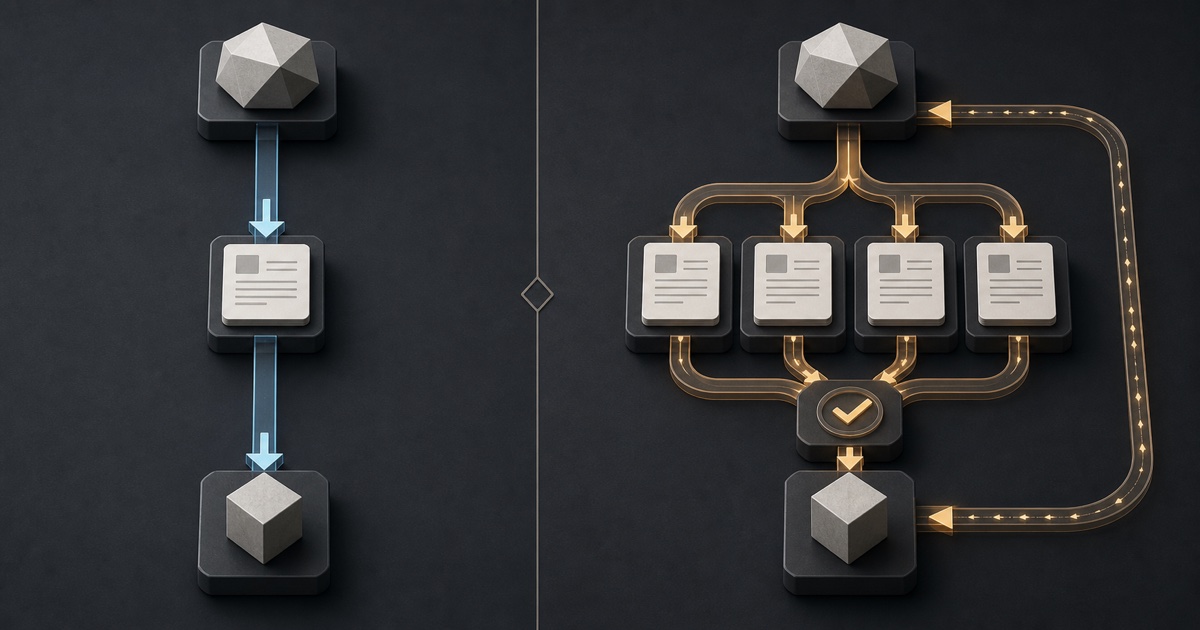
Quick answer: Retrieval-augmented generation, or RAG, supplies a model with information retrieved through a designed pipeline. Agentic RAG adds a controller that can decide whether retrieval is needed, choose among sources, rewrite queries, inspect results, and try another step. Use ordinary RAG when the path is predictable. Add agentic control when bounded ambiguity justifies more latency, cost, and evaluation work.
Agentic RAG is not automatically more accurate. It creates more ways to recover—and more ways to fail.
Key facts
- RAG is a retrieval pattern; agentic RAG adds decision-making around that pattern.
- Conventional RAG can already use hybrid search, reranking, filters, and multiple queries.
- “Agentic RAG” is an evolving umbrella term, not one standardized architecture.
- Adaptive retrieval adds tool calls, variable latency, loops, and a larger test surface.
- Both approaches still need source attribution and an answer that distinguishes evidence from inference.
RAG and agentic RAG defined
In a typical RAG system, an application transforms a question into a search, retrieves passages from a defined source, places selected passages in the model context, and asks the model to answer. Engineers decide the retrieval sequence in advance.
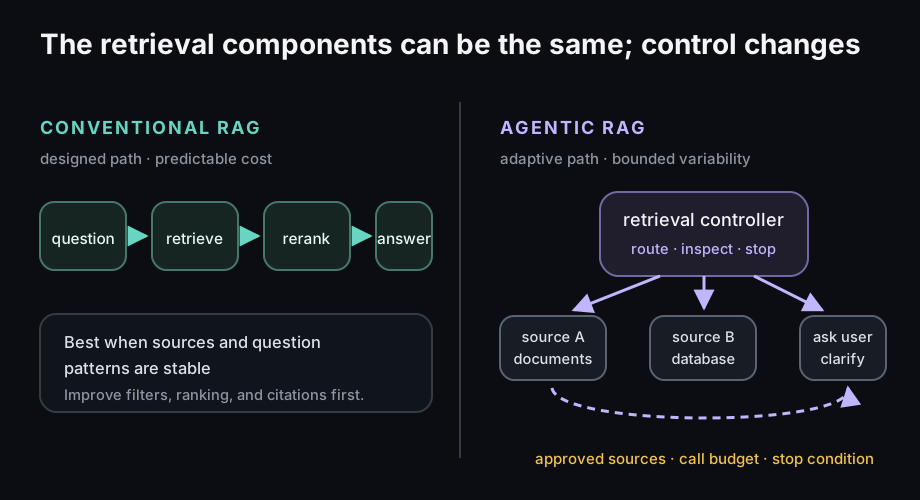
In agentic RAG, an agent controls some of those decisions. It might classify the question, skip retrieval for a simple calculation, query two different repositories, notice that dates conflict, narrow the query, and then compose an answer. The retrieval components may be identical; the controller changes.
RAG vs agentic RAG at a glance
| Dimension | Conventional RAG | Agentic RAG |
|---|---|---|
| Retrieval control | Application-defined path | Agent chooses within defined tools and limits |
| Query behavior | Fixed or rule-based transformations | Can reformulate based on intermediate results |
| Sources | Usually known in advance | May route among approved sources |
| Latency and cost | More predictable | Variable; may require several calls |
| Failure modes | Poor chunking, ranking, grounding | Those failures plus bad routing, loops, and premature stopping |
| Evaluation | Retrieve and answer against known cases | Also test decisions, sequences, budgets, and stopping |
| Best fit | Repeated questions over stable material | Questions whose evidence path varies meaningfully |
The first column is not “basic RAG.” A carefully engineered fixed pipeline can outperform an agentic one when the task is stable.
Illustrative example: one reimbursement-policy question
The policies and addendum in this synthetic scenario are invented and are not legal or reimbursement guidance. Consider: “Can a California employee claim a hotel meal that exceeded the normal cap because a delayed flight forced an overnight stay?”
The evidence lives in three places: the company reimbursement policy, the travel exception policy, and a California addendum. A conventional RAG pipeline can search all three collections every time, rerank the passages, and return a source-linked answer. If the source set and question type are stable, that may be the best design.
An agentic retrieval flow might:
- identify the question as an exception case;
- retrieve the base meal limit;
- inspect the travel policy for disruption exceptions;
- detect the employee's jurisdiction and retrieve the relevant addendum;
- compare effective dates;
- ask for the receipt date if the answer depends on a policy revision;
- cite the governing passages and mark any remaining uncertainty.
That behavior helps only if the agent has bounded source access, a call budget, reliable date handling, and a rule against inventing missing policy.
When conventional RAG is the better choice
Choose a designed retrieval pipeline when:
- the corpus and question patterns are known;
- the same filters and sources apply to most requests;
- response time and cost need tight bounds;
- the organization can maintain a representative evaluation set;
- auditability benefits from a consistent path.
Improving chunking, metadata, query construction, ranking, or citations often solves the problem without an agent.
When agentic RAG earns its complexity
Consider agentic control when:
- different question types require different repositories or tools;
- retrieval should sometimes be skipped;
- useful evidence depends on intermediate findings;
- conflicting sources require another query or a clarification;
- a multi-hop task cannot be expressed cleanly as a fixed sequence.
Define the boundary first. Approved sources, maximum retrieval attempts, timeouts, token budgets, and stop conditions turn open-ended search into a controlled capability.
Limitations to test
Agentic retrieval may keep searching after it already has enough evidence, choose a plausible but wrong source, or mistake retrieval volume for certainty. It may also produce variable traces that are harder to compare.
Evaluate more than final-answer similarity. Check whether the system selected the right source, preserved effective dates, cited supporting passages, requested missing facts, stopped within budget, and declined when evidence was insufficient.
Where Agenaxy fits
Agenaxy treats retrieval as part of a visible agent run. A Space can hold the files, rules, tool permissions, sessions, evidence, and artifacts for a project while the selected local or cloud model remains replaceable. The useful record is not just the answer; it is which context entered the run, what tools were used, and what evidence supports the delivered artifact.
For persistence across runs, see what AI agent memory means. For deciding whether a fixed process needs agent control at all, compare AI agents with workflow automation.
Test one source-heavy workflow
Describe a bounded evidence task in an Agenaxy beta request. Do not submit confidential documents, customer records, credentials, or production data through the form.
FAQ
Is agentic RAG always multi-agent?
No. One agent can control retrieval. Multiple agents are an architecture option, not part of the definition.
Does agentic RAG replace a vector database?
No. It can call vector search, keyword search, databases, web search, or other approved tools. The agent controls the retrieval path; it does not eliminate retrieval infrastructure.
Can conventional RAG use multiple queries?
Yes. Query expansion, reranking, filters, and multi-stage retrieval can all be designed into a conventional pipeline without giving an agent control.
Sources and Fact-Checking Notes
- Retrieval-Augmented Generation, NeurIPS 2020 introduced the influential RAG formulation combining parametric and retrieved knowledge.
- Adaptive-RAG, NAACL 2024 studies routing questions among different retrieval strategies.
- Self-RAG, ICLR 2024 studies self-reflection around retrieval and generation.
- “Agentic RAG” is used here as an operational category, not a single formal standard.