Single Agent vs Multi-Agent Systems: When More Agents Actually Help
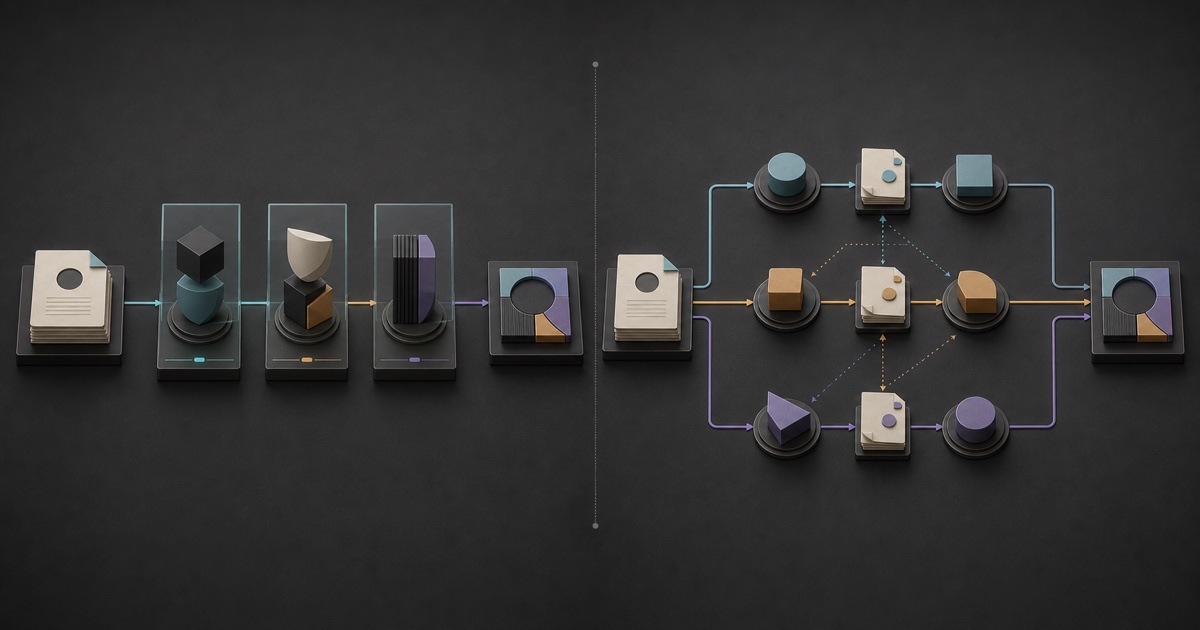
Quick answer: Start with one capable agent. Move to a multi-agent system only when the task can be cleanly decomposed, work can run in parallel, specialist tools or permissions need separation, or an independent role produces measurable improvement. More agents add handoffs, coordination failures, latency, token use, and a larger evaluation surface. Agent count is an architecture choice, not an intelligence multiplier.
The fair test is one task, one rubric, and two implementations.
Key facts
- One agent can plan, research, draft, verify, and revise in stages.
- Multi-agent systems exchange messages or artifacts; every handoff can lose context.
- Separate agents can carry distinct prompts, tools, models, permissions, or ownership.
- Parallel calls reduce elapsed time only when the work is actually independent.
- Build a single-agent baseline before attributing gains to orchestration.
Single-agent vs multi-agent systems
| Dimension | Single-agent system | Multi-agent system |
|---|---|---|
| Control | One loop owns the task | An orchestrator or protocol coordinates several loops |
| Context | Shared directly within one run | Selected context must cross handoff boundaries |
| Specialization | One agent changes stages, tools, or instructions | Roles can have distinct models, tools, and policies |
| Parallelism | Usually sequential, though tools may run concurrently | Independent work can run in parallel |
| Failure modes | Bad plan, context drift, tool errors, premature stop | Those failures plus routing, deadlock, duplication, and handoff loss |
| Cost and latency | Easier to estimate | Additional calls and coordination create variability |
| Evaluation | Test one trajectory and outcome | Test each role, handoff, interaction, and final outcome |
| Best default | Most bounded workflows | Proven decomposition or isolation needs |
“Multi-agent” covers many designs: a manager delegating to workers, peers debating, a pipeline of specialists, or agents operating under separate permissions. These architectures should not be evaluated as one feature.
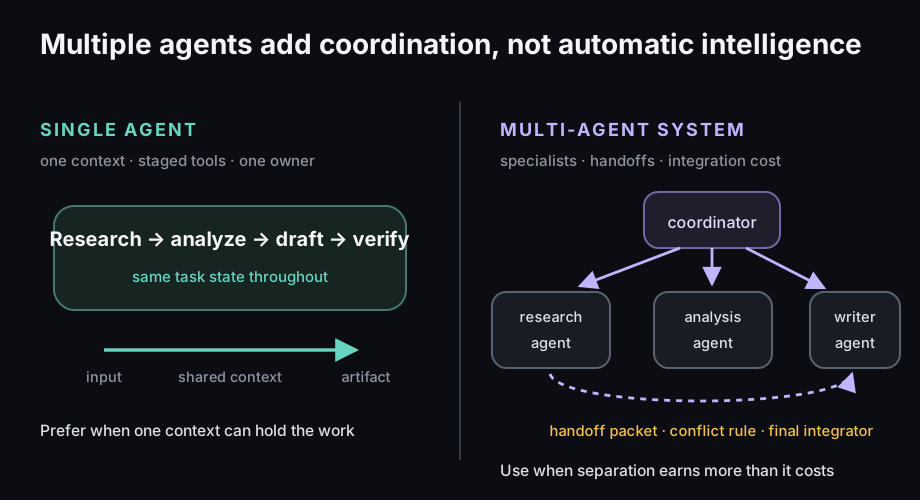
Illustrative example: one market brief
This is a synthetic comparison, not a benchmark or customer result. The task is: research a market change, write a two-page brief, verify every factual claim, and deliver a source-linked document.
In the single-agent design, one agent follows explicit stages:
- define the research questions and source rules;
- collect and record evidence;
- draft against a fixed outline;
- run a claim-by-claim verification pass;
- repair unsupported statements and deliver the artifact.
In the multi-agent design, a researcher produces a structured evidence packet, a writer drafts only from that packet, and a verifier checks every claim against the sources. The orchestrator rejects incomplete handoffs and returns findings to the writer.
Measure both on the same cases: factual error rate, citation accuracy, coverage, revision count, total model calls, tokens, elapsed time, and human correction time. If the three-agent design merely costs more while returning the same brief, it did not earn its complexity.
When one agent is usually better
Prefer a single agent when the task is tightly coupled, benefits from one shared context, has modest scope, or requires frequent movement between reasoning and action. It is also easier to debug, secure, and evaluate.
A staged prompt or state machine can create useful role separation without a network of agents. Tool access can change by stage, and an independent verification call can still be added without turning the entire workflow into a multi-agent architecture.
When multiple agents can help
Use separate agents when at least one of these conditions is testable:
- independent subtasks can run in parallel;
- distinct domains need different models, instructions, or tool sets;
- permission boundaries should prevent one role from performing another role's actions;
- context would be clearer when each agent receives a narrow packet;
- independent generation and verification reduce correlated errors;
- organizational ownership requires explicit responsibility and receipts.
Define the handoff as a contract: required fields, source links, confidence, unresolved questions, version, and acceptance checks. “Research complete” is not a useful packet.
Coordination costs and failure modes
An orchestrator can route a task to the wrong specialist. Two workers can duplicate the same research. A writer can ignore caveats from the evidence packet. Agents can debate without converging or accept each other's plausible error. A failing worker may cause the system to retry an external side effect.
Bound the number of agents, turns, retries, and total cost. Make handoffs inspectable. Preserve one source of truth for task state. Verify final environment state rather than trusting consensus.
A practical decision rule
First make the single-agent design strong: focused task, appropriate context, typed tools, clear stages, acceptance tests, and bounded permissions. Then name the hypothesized benefit of splitting—parallel speed, specialist quality, isolation, or independent verification.
Run both on representative cases. Keep multiple agents only if the benefit exceeds the added operational and evaluation burden.
Limitations
Research on multi-agent systems depends heavily on the task, model, communication protocol, budget, and baseline quality. A positive result for debate, software development, or simulation does not establish a general rule for all agent work.
Vendor frameworks also change quickly. Treat current orchestration features as implementation options, not evidence that the architecture is necessary.
Where Agenaxy fits
Agenaxy gives agent work a durable Space containing files, rules, model preferences, permissions, sessions, execution evidence, and artifacts. That supports the essential baseline: make one bounded workflow visible and testable before adding coordination.
The important unit is the inspectable result, not the number of agent personas involved. Start with what an AI agent is and use the agent reliability control stack to compare designs.
Test one proposed agent split
Describe a bounded task and why you think it needs specialist roles in an Agenaxy beta request. Do not submit confidential documents, customer records, credentials, or production data.
FAQ
Are multi-agent systems smarter than one agent?
Not inherently. They can combine specialization or parallel work, but they can also amplify errors and lose context. Test the complete system against a strong baseline.
Is a reviewer agent a multi-agent system?
It can be. A separate reviewer call creates independent execution, but the useful question is whether its isolation and rubric improve the outcome enough to justify the additional step.
Do multiple agents require different models?
No. Several agents may use the same model with different roles and tools, or different models chosen for specific tasks.
Sources and Fact-Checking Notes
- OpenAI, A Practical Guide to Building Agents recommends maximizing a single agent before adding multi-agent complexity and describes orchestration patterns.
- AutoGen presents one framework and research approach for multi-agent conversation.
- Stop Overvaluing Multi-Agent Debate — We Must Rethink Evaluation and Embrace Model Heterogeneity studies limitations in debate-style evaluation and cautions against treating multi-agent debate as universally beneficial.
- Agenaxy statements are checked against its Space, agent execution, permission, Trace, and Artifact canon.